👑 English vs. American Budgie: Key Differences and Care Needs
Introduction: The Battle of the Budgies!
Hello, bird lovers! Did you know that when people talk about budgies (or parakeets), they are often talking about two different birds that share the same DNA? It’s like comparing a regular-sized cup of coffee to an extra-large one!
We have the American Budgie (often just called the common pet budgie or “parakeet”) and the English Budgie (also known as the Exhibition Budgie). Both are beautiful, both are cheerful, and both come from the same sunny Australian ancestor. But they have some huge differences in looks, personality, and even health needs!
Why does this matter? Because if you buy a tiny bird and it suddenly grows a gigantic, fluffy head, you need to know what you’re dealing with!
Get ready to learn the key differences between these two feathery friends and how to care for them like a pro.
📏 Section 1: The Tale of the Tape (Physical Differences)
This is the easiest way to tell them apart: size, head shape, and floof (fluff)!
⚖️ Subheading 1: “Size Matters: The Giant vs. The Speedy Racer”
This is the top searched question when people first see an English Budgie.
| Feature | 🇺🇸 American Budgie (Pet Parakeet) | 🇬🇧 English Budgie (Exhibition Budgie) |
| Size/Length | Small (around 6–7.5 inches long) | Large (up to 9–10 inches long) |
| Weight | Very light and speedy (around 1 oz / 28 grams) | Much heavier and chunkier (up to 2 oz / 57 grams) |
| Body Shape | Slim, streamlined, and agile (looks like a wild budgie) | Stocky, wide, and heavy-set (looks like a tiny parrot) |
| Lifespan | 7–15 years (with good care) | 5–9 years (often shorter due to selective breeding) |
Funny Fact: The English Budgie is so much bigger and heavier that it looks like the American Budgie’s very fluffy, overfed cousin! The American Budgie is built like a racer; the English Budgie is built like a football player.
The Floof Factor: The Helmet Head
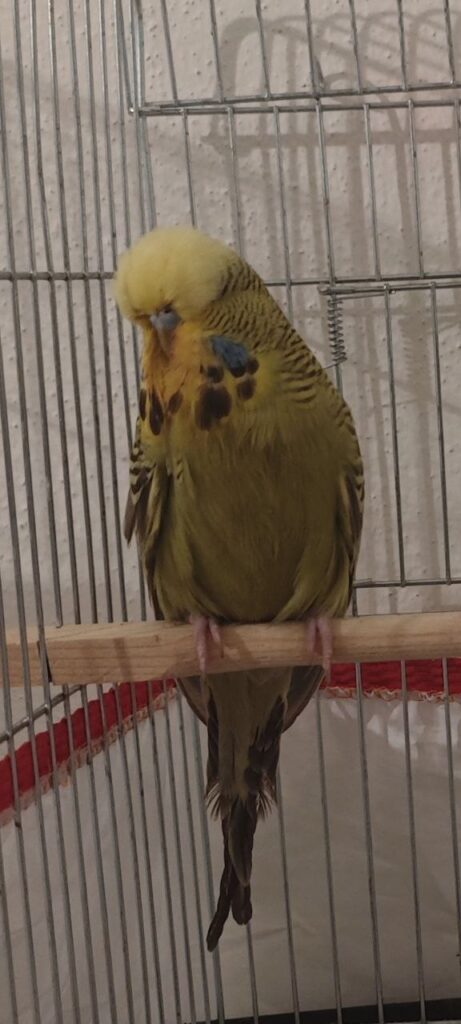
The biggest visual giveaway is the head.
- American Budgie: Has a neat, smooth head. The feathers lie flat and the beak is clearly visible.
- English Budgie: Has massive, thick, puffy head feathers, often described as a “hood” or a “helmet.” These feathers cover much of their face and sometimes even hide their eyes and beak! This floof is specifically bred for show competitions.
Neck Spots (Masks)
Look at the black spots on their cheeks (called “throat spots” or the “mask”).
- American Budgie: Has a neat row of six small, clear black spots.
- English Budgie: Has huge, long, and numerous throat spots that often overlap and run much lower down the chest, buried under all that helmet fluff!
🧠 Section 2: Personality and Brainpower
Do size and fluff change their behavior? Absolutely!
🗣️ Subheading 2: “Which Budgie is Better at Talking and Taming?”
This is a key area where most owners want information!
| Feature | 🇺🇸 American Budgie | 🇬🇧 English Budgie |
| Activity Level | Very high energy, loves to fly and zip around the room. | Much calmer, lazier, and happier to just sit and perch. |
| Taming Speed | Can be more skittish and nervous, requiring more patience. | Due to their calm nature, they are usually easier and quicker to hand-tame. |
| Talking Ability | Superb! They are excellent talkers and chatterers and are often the ones setting Guinness World Records for the largest vocabulary. | Good, but often quieter. They can talk, but their giant head feathers can muffle the sound, and they don’t have the same drive to chatter. |
The Fluffy Head Secret: Because the English Budgie’s feathers cover their eyes and they are so heavy, they can’t see or move as quickly. This makes them feel less threatened by your hand, making taming easier! But if you want a bird that flies circles around your head and sings operas, the American Budgie is your superstar.
🍎 Section 3: Care Needs and Health Warnings
Because the English Budgie is an extreme example of selective breeding, they often have more specific care needs than their wild-type American cousins.
🏥 Subheading 3: “Health Warnings: What English Budgie Owners Must Know”
English Budgies are basically the “show dogs” of the bird world—they look fantastic, but they can be a bit more fragile.
- The Floof Problem (Heat and Vision): That huge head of feathers is cute, but it’s a burden. They can overheat much faster than American Budgies, so you must watch the room temperature. Also, those long feathers can block their vision, so make sure they have a clear path to food and water.
- Shorter Lifespan: Because breeders focus on size and feather quality, sometimes genetic health takes a backseat. English Budgies are generally more prone to tumors (especially thyroid tumors) and heart issues. Their shorter lifespan (5-9 years vs. 7-15 years) is a factor every owner must consider.
- Bigger Everything: An English Budgie needs a much bigger cage and thicker perches than an American Budgie. Their feet are larger, and they need more room to move their large bodies without damaging their show feathers. Standard American budgie cages are often too small!
- No More Millet? Both types love millet, but English Budgies, because of their slower metabolism and shorter life expectancy, need an even stricter diet. You must be super serious about the 70% pellet diet and limit fatty seeds to prevent obesity and related tumors.
🦜 Summary: Choosing Your Budgie Buddy
| If You Want… | Choose the American Budgie | Choose the English Budgie |
| A chatty superstar | ✅ Yes! | ❌ No, they are quieter. |
| A marathon flyer | ✅ Yes! | ❌ No, they are happier perching. |
| A big, gentle bird | ❌ No, they are small and speedy. | ✅ Yes! |
| The longest possible life | ✅ Yes! (Up to 15 years) | ❌ No (Often 5–9 years) |
| Easy, quick hand-taming | ❌ Might take more time. | ✅ Yes! (Usually easier) |
No matter which one you choose, both budgies need the same core things: a clean cage, fresh water, a 70% pellet diet, and lots of love and interaction!
❓ Frequently Asked Questions (FAQ)
Q: Can English and American Budgies live in the same cage?
A: Yes, they can! They are the same species, so they get along just fine. However, be aware that the larger English Budgie might accidentally bully the smaller American Budgie off a favorite perch or food dish. Make sure the cage is large enough so the American Budgie has plenty of space to escape and fly.
Q: Does the English Budgie need a special type of food?
A: Not a special type, but a stricter type. They absolutely need a 70% pellet diet and lots of fresh vegetables. Their genetics make them more prone to fatty tumors, so a high-fat seed-only diet is even riskier for them than it is for American Budgies. Fat is their biggest enemy!
Q: How can I tell if a breeder is selling me an American Budgie or an English Budgie?
A: If the bird is young, it can be tricky, but the price is usually the biggest clue!
- American Budgies are generally inexpensive and widely available in pet stores.
- English Budgies are usually sold by specific breeders (called “Exhibition Breeders”) and are often two to five times the price of an American one because of their pedigree and size. Just look at the size of the parents!
Q: Should I trim the feathers around my English Budgie’s eyes if they can’t see?
A: You should only trim or clean feathers if a licensed avian vet tells you to do so. Generally, if the bird is healthy, they will manage their own feathers. But if the feathers are getting dirty from food or water and blocking their sight, a vet might recommend a gentle “feather clean-up” around the mask area for better vision.
Conclusion: Two Kinds of Joy!
Whether you have a sleek, speedy American Budgie or a fluffy, giant-headed English Budgie, you have a charming and intelligent companion. Knowing their subtle differences helps you provide the perfect environment and diet, ensuring they stay happy and healthy for many years!