 İçeriğe atla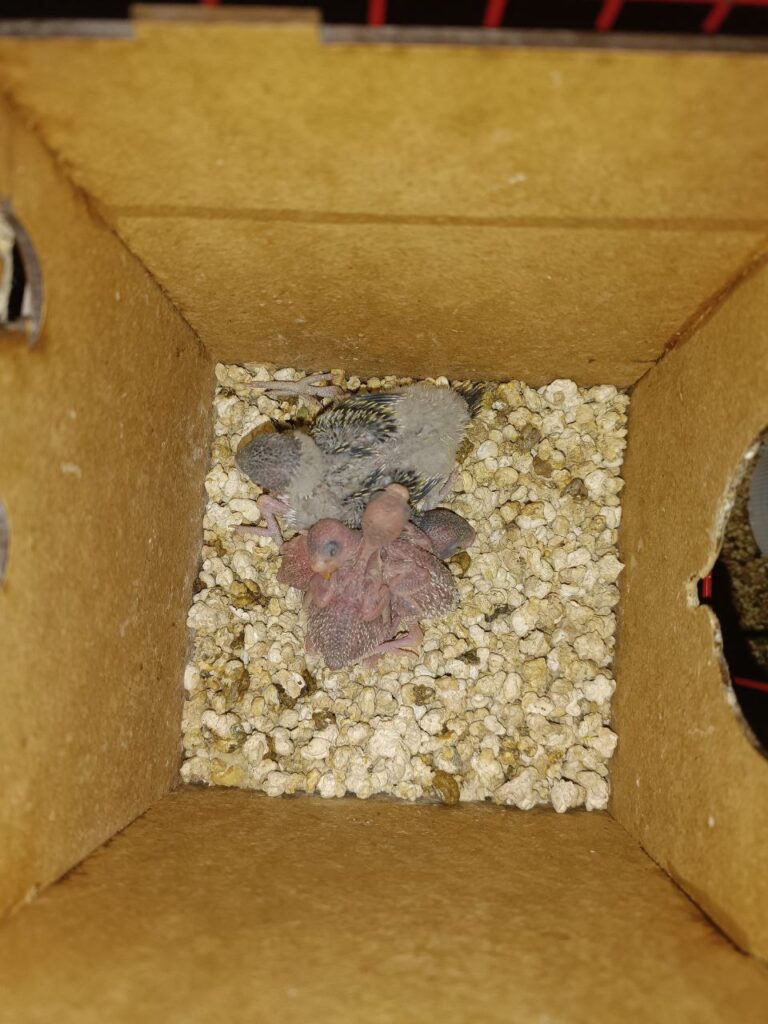
The Budgie Egg Timeline: From Laying to Hatching
The budgie hen (female) will typically lay eggs in a dark, secure nest box (or in a hidden corner if no box is provided). Here is the general schedule:
🥚 1. Laying the Clutch
- Egg Count: A hen typically lays a clutch of 4 to 8 eggs.
- Laying Schedule: She will usually lay one egg every one to two days. This is why the chicks will all hatch on different days, leading to a big difference in size between the oldest and youngest chick.
- Fertility: A female budgie can and often will lay eggs even without a male present. These eggs are, of course, infertile and will never hatch.
🗓️ 2. Incubation
- Start Time: The hen often won’t begin the full-time incubation (sitting on the eggs constantly) until the second or third egg is laid. This helps the chicks hatch closer together.
- Incubation Period: Budgie eggs typically take 18 days to hatch, though this can sometimes stretch up to 21 days.
- Incubation Conditions: The hen is responsible for keeping the eggs at the perfect temperature (around $37.0^\circ\text{C}$ or $98.6^\circ\text{F}$) and ensuring enough humidity. Disturbing her during this time can cause her to abandon the nest.
🐦 3. Hatching and Growth
- Hatching Staggered: Because she laid the eggs on alternate days, they will hatch on alternate days. This means the oldest chick can be a week or more older than the youngest chick!
- The Runts: The youngest chick is often called the “runt” and can struggle to compete for food with its older, larger siblings.
🛑 What to Do When Your Hen Lays an Egg (Accidental Clutch)
If your pet female budgie lays an egg outside of a planned breeding setup, do not panic or immediately remove the egg!
- Check Her Calcium: Egg-laying is physically draining and leaches calcium from her body, which is necessary for strong eggshells. Immediately ensure she has a cuttlefish bone and a mineral block accessible. You can also offer a small amount of boiled egg (with the shell crushed and mixed in) as a vital calcium source.
- Leave the Eggs Alone: Removing the egg (or the entire clutch) immediately will trick her body into thinking the clutch was lost, causing her to lay more eggs to replace them. This can lead to chronic egg laying, which can kill her.
- Hormone Reduction: The best long-term strategy is to trick her body into thinking it’s not breeding season.
- Ensure she gets 12 to 14 hours of total, uninterrupted darkness every night.
- Reduce high-fat seeds and switch her toward a pellet and vegetable diet.
- Remove any dark, cozy nesting spots like happy huts or small boxes.
- Replace with Fakes (If Necessary): If the eggs are infertile, let her sit on the clutch for about 7–10 days. Then, gently replace the real eggs with fake ceramic or plastic eggs. Let her sit on the fakes until she naturally abandons them (usually a few weeks). This calms her hormones without depleting her body further.
🔬 Candling: Checking if an Egg is Fertile
“Candling” is the term for holding a light up to the egg to see what’s inside.
| Day of Incubation | Appearance if Fertile | Appearance if Infertile |
| Day 3–5 | You should see fine, spider-like red veins spreading out from a central dark spot (the embryo). | The egg will look completely clear inside, like a plain, illuminated sphere. |
| Day 7–10 | The egg should look mostly dark and opaque, with a clear air sac at the blunt end. | Still clear, possibly with a small dark blob that has no visible veins. |
Important Note: If you are a beginner, it is best to minimize handling the eggs to prevent contamination or damage. If the egg has not hatched by Day 23, it is safe to assume it will not.
